Clay soil that swells after each rainy episode, a terrace adjacent to the house that pulls on the facade after two winters: the foundation of a concrete terrace is not chosen from a catalog. It is decided on-site, after observing the nature of the soil and the constraints of the project.
Shrink-swell of clays and concrete terrace foundation: the trap of seemingly stable soil
It is often thought that hard soil in summer will easily support a concrete slab. On clayey ground, the opposite occurs. The clay swells with water, shrinks during dry periods, and this cyclical movement creates tensions capable of cracking a poorly founded slab in just a few seasons.
The ELAN law and its implementing decrees have made a prior geotechnical study (G1) mandatory for individual houses and their annexes in exposed areas. Terraces attached to buildings fall within this scope. The BRGM publishes shrink-swell hazard maps that cover the entire territory: before any project, these maps should be consulted to determine if the land requires specific precautions.
On identified risky clay soil, the foundation must extend below the drying zone (the surface layer that undergoes moisture variations). In practical terms, this means deeper footings than on sandy or limestone soil. Another common option is to decouple the terrace from the building with a break joint so that soil movements do not damage the facade.
To properly choose the foundation for a concrete terrace, we start with the soil, not the covering.
Full slab, adjustable pedestals, or strip footings: what type of foundation for which terrain
The choice between a slab on grade, adjustable pedestals, or strip footings depends on three concrete parameters: the load-bearing capacity of the soil, the slope of the terrain, and whether the terrace is attached or independent of the building.

Concrete slab on draining gravel
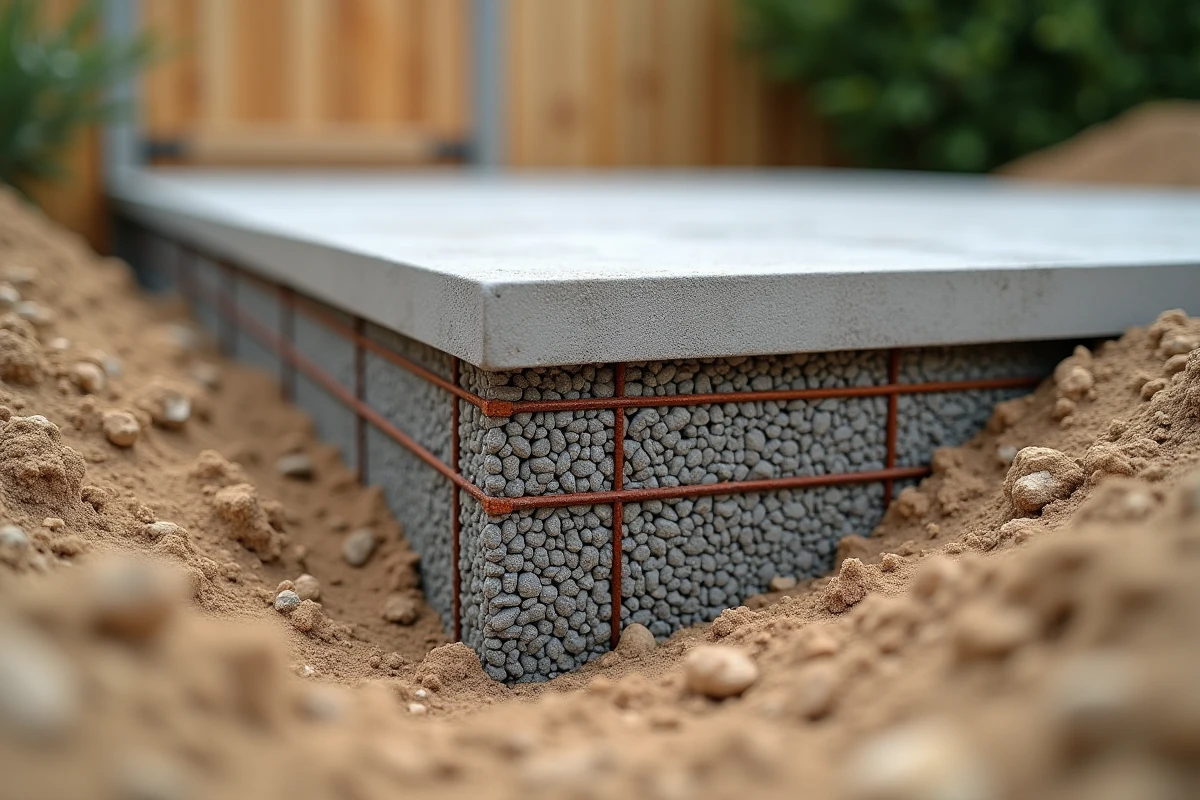
This is the classic solution when the soil is stable and well-drained. We excavate, lay a bed of compacted gravel (the gravel bed), and then pour the slab with a welded mesh. Stability relies on careful compaction of the gravel bed, not just on the thickness of the concrete. A poorly compacted gravel bed causes differential settling, even under a thick slab.
Adjustable pedestals on hard soil
Adjustable pedestals are suitable when there is already a load-bearing surface (old slab, very compact soil). They allow for leveling differences and permit air circulation under the joist structure. On soft or wet ground, the pedestals gradually sink: this solution should be avoided without a rigid support underneath.
Strip footings or beams
On sloped terrain or heterogeneous soil, strip footings provide a more reliable linear base than a floating slab. They are also used when the terrace must support a significant load (spa, masonry planter). The joists or load-bearing structure rest on these footings, which decouples the terrace from the natural ground.
- Clay or unstable soil: deep footings or beams, decoupling from the building, mandatory peripheral drainage
- Well-drained sandy or limestone soil: slab on compacted gravel, the most direct and least expensive solution
- Sloped terrain or existing surface: adjustable pedestals on an old slab, or strip footings to compensate for the elevation
- Terrace attached to the building in clayey area: break joint between the foundation of the house and that of the terrace
Management of rainwater under the terrace: a regulatory constraint that influences the foundation
This point is often overlooked, but it can dictate the type of foundation chosen. More and more municipalities, through their PLU and territorial climate-air-energy plans, impose source management of rainwater for impermeable surfaces. Some recent building permits explicitly prohibit discharging terrace water into the sewage system.
In practical terms, this leads to permeable or semi-permeable solutions. Draining concrete, for example, allows water to infiltrate through the slab without runoff. Its implementation differs from conventional concrete: the mix is more porous, and the foundation below must include a temporary storage layer (graded gravel) to absorb water volumes before infiltration into the soil.
If the soil is poorly permeable (clay, compact silt), a peripheral drain or infiltration well should be associated with the foundation. The additional cost is real, but feedback varies on this point: some contractors include drainage from the outset without notable extra charges, while others bill it as a separate item. In any case, checking the local PLU requirements before pouring anything avoids the need to break and redo.
Slab thickness and reinforcement: adapting the technique to the actual load
Oversizing a terrace slab is costly in terms of concrete and labor. Undersizing guarantees cracks. The thickness and reinforcement are adjusted on a case-by-case basis.
For a pedestrian terrace without heavy loads, a moderately thick slab with standard welded mesh is sufficient. If a spa or heavy furniture is planned, the reinforcement must be locally strengthened under the load points. Adding reinforcements under the feet of a spa rather than thickening the entire slab is more rational and economical.
The span of the slab also plays a role. A narrow terrace (less than two meters wide) does not behave like a large surface terrace. The greater the span, the more the risk of bending requires appropriate reinforcement. The DTU and industry standards set minimums, but difficult soil or atypical geometry justify consulting a structural engineering firm.
- Standard pedestrian terrace: slab of common thickness, welded mesh, compacted draining gravel
- Terrace with point load (spa, masonry barbecue): localized reinforcement of reinforcement under supports
- Large surface or complex shape: control joints to limit shrinkage cracking
Control joints, indeed, are the detail that is most often forgotten. Beyond a certain surface area, concrete shrinks as it dries and cracks if nothing channels this contraction. Cutting the slab into panels with joints every few linear meters channels the cracks into the joints rather than in the middle of the terrace.
The foundation of a concrete terrace rarely boils down to pouring concrete on gravel. Soil, local regulations, expected loads, and drainage form a technical whole where each parameter modifies the others. Starting with a soil analysis and a review of the local PLU remains the most reliable method to avoid having to redo the foundation two years after installation.