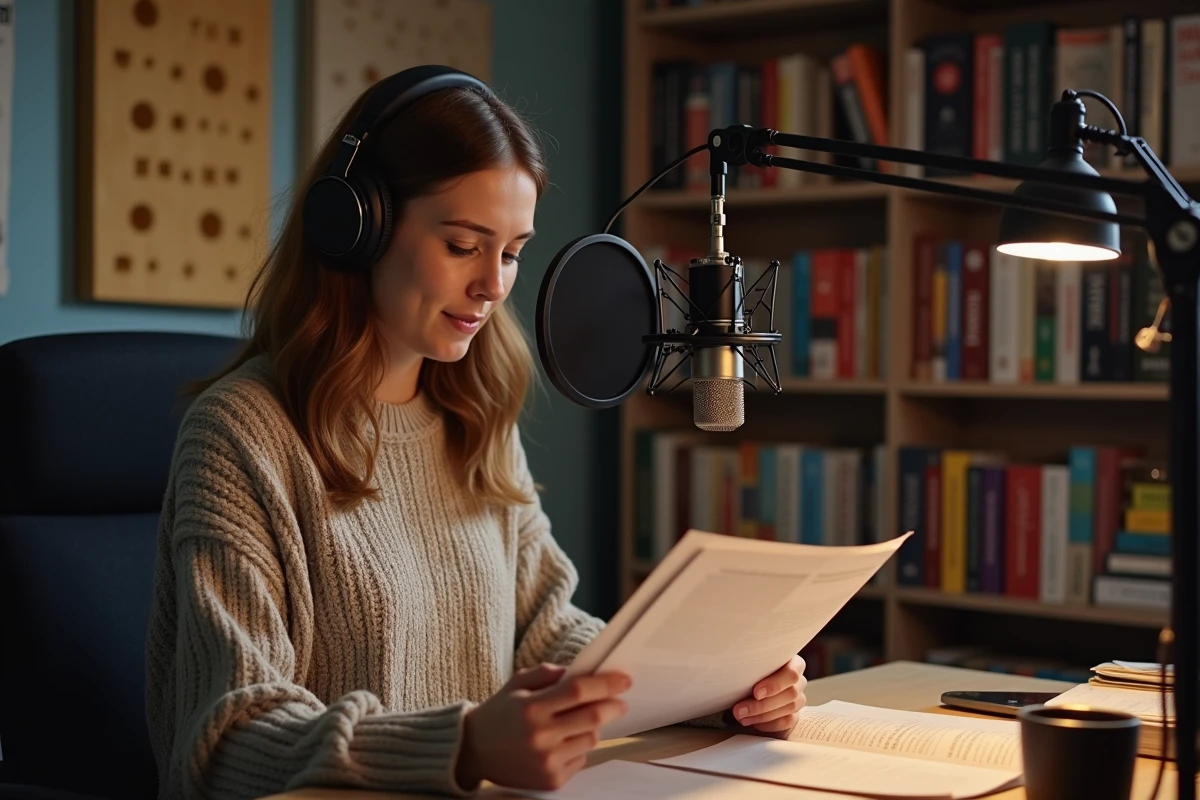
The audiobook market is experiencing rapid growth in France, driven by platforms like Audible, Spotify, and independent players. In this context, the idea of making money related to audiobooks is becoming increasingly appealing. However, behind the term “paid audiobook reader” lie very different realities that most online guides fail to distinguish.
Listening or narrating: two activities that the market does not compensate in the same way
Confusion is everywhere. A quick search suggests that one can be paid simply for listening to audiobooks. The results mix two unrelated activities: professional narration and passive paid listening.
Narration involves lending one’s voice to a work, recording it in a studio or at home, and then distributing it on platforms. It is a production job that requires vocal, technical, and literary skills. Earnings vary depending on experience and the chosen compensation model.
Paid listening, on the other hand, falls into a completely different category. Some apps or survey sites offer to rate audio excerpts, provide feedback on the quality of narration, or fill out questionnaires after listening. The income from passive listening remains negligible, amounting to just a few euros per month. For anyone looking to become a paid audiobook reader, narration is the only path that generates significant income.

Skills and equipment to become an audiobook narrator
Narrating an audiobook is not just about reading a text aloud. Platforms like ACX (the production branch of Audible) impose increasing quality standards. In recent years, raw or poorly processed audio files have been systematically rejected.
What the voice must convey
Clear enunciation is not enough. The narrator must know how to manage pacing, modulate emotions, and differentiate characters in a novel. Experience in theater, dubbing, or public speaking is a real asset. Field feedback shows that narrators who have taken drama classes more easily secure their first contracts.
Minimum technical equipment
- A quality condenser microphone capable of capturing vocal nuances without background noise
- An acoustically treated recording environment, even if improvised (thick blankets, foam, quiet room)
- Audio editing software to clean up recordings, equalize sound, and export in formats required by platforms
Audio quality has become a disqualifying criterion on most distribution platforms. A recording made with a laptop’s built-in microphone will be rejected, regardless of the reader’s talent.
Compensation on ACX and Audible: the models to know
ACX, owned by Amazon, remains the main channel for distributing an audiobook on Audible. Three compensation models coexist, and the initial choice affects earnings throughout the title’s lifespan.
- Pay-per-finished-hour (PFH): the narrator receives a fixed amount per hour of audio produced. This model is suitable for beginners who want to secure immediate income
- Royalty share: the narrator receives a percentage on each sale or listen. No upfront payment, but potential for recurring income if the title sells well
- Hybrid model: a reduced upfront payment, supplemented by a share of royalties. This is a compromise, but it remains less common in practice
The royalty share only becomes profitable if the book reaches a sufficient sales volume. For a beginner narrator without an audience, pay-per-finished-hour offers better predictability. However, a well-positioned niche title can generate passive income over several years through royalties.
The available data does not allow for a universal rate to be set. The ranges depend on the literary genre, the author’s notoriety, and the narrator’s positioning. Discussions in English-speaking narrator communities mention very wide disparities based on experience.

Limits and realities of the audiobook reading profession in France
The Francophone market remains narrower than the Anglophone market. The French Audible catalog is expanding, but the demand for Francophone narrators is growing less quickly than that for Anglophone narrators. This gap has a direct consequence: the competition for each Francophone project is more intense.
Moreover, the arrival of AI-generated voice synthesis is changing expectations. Some publishers are testing generated voices for non-fiction works or practical guides, reserving human narrators for novels and literary texts. This trend has not yet disrupted the market, but it pushes narrators to position themselves in areas where the human voice adds clear value: emotion, characters, tone.
Status and income declaration
In France, income from audio narration must be declared. Depending on the volume of activity, the micro-entrepreneur status suits most occasional narrators. Royalties received via ACX are subject to taxation applicable to foreign income, which requires checking the tax treaties between France and the United States.
Field feedback varies on the actual administrative simplicity. Some narrators report difficulties in obtaining an ITIN (Individual Taxpayer Identification Number) necessary to reduce the withholding tax applied by Amazon.
The profession of paid audiobook reader does exist, but it is based on vocal production, not passive listening. Anyone considering this activity should first invest in the quality of their recording and mastery of their voice before worrying about platform choice.