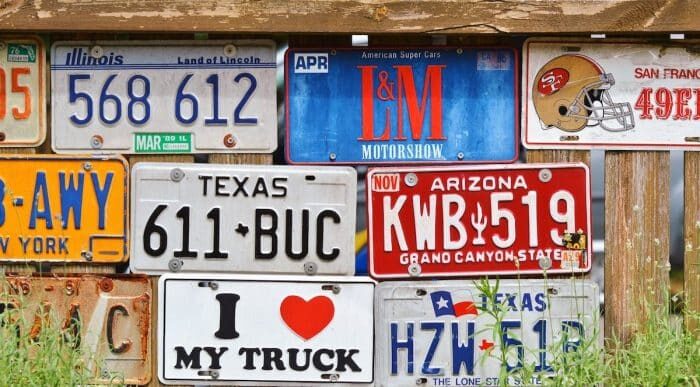
License plates, although designed for a universal function – the identification of vehicles – exhibit an astonishing diversity from one country to another. The colors, formats, typefaces, and even the information they convey reflect the cultures, histories, and local regulations. From the uniform European blue to plates adorned with the emblems of U.S. states, and including plates displaying the full name of the state in some Asian countries, this overview explores the uniqueness of these small pieces of metal or plastic that are an integral part of our daily road landscape.
The history of license plates: from their creation to the present day
Let’s go back to the Roman era, where the first rudiments of vehicle regulation and identification emerged. At that time, they consisted of bronze plates representing the name of the owner of the cart or the harnessed horse.
At the turn of the 20th century, it was France that innovated with a unique system that could today be called ‘red license plate’. Established as early as 1901, this system used red letters on a white background to facilitate the visual identification of vehicles by the competent authorities. This bright color also made these plates easily readable at night.
By the mid-20th century, each country began to develop its own designs and formats to meet specific legal requirements as well as to reflect their unique national identity. Thus, some countries opted for different color codes depending on the geographical region or used various local symbols to differentiate their vehicles.
In America, for example, each state has its own customizable design ranging from a simple local landscape emblem of the state to an original tourism slogan inscribed on it. The numbering systems also vary greatly between nations: while some adopt alphanumeric series based on arbitrary combinations, others prefer to use a more complex code that changes according to various criteria such as the date or place of registration.
Today in the 21st century, thanks to technological advancements, new features have been added to license plates. Technologies such as automatic number plate recognition (ANPR) can be seen, allowing for more accurate tracking and better detection of vehicles involved in illegal activities.
The ‘red license plate’ as well as all other variations around the world thus play a crucial role in the quick and effective identification of vehicles, thereby facilitating the investigative work related to traffic offenses.
In summary, these rectangular pieces of metal on our cars are much more than just an accessory: they are a cultural reflection unique to each country, testifying to the perpetual need for each nation to identify its vehicles while preserving its unique identity.
License plates: a world tour of styles and designs
Now let’s dive into a fascinating exploration of the different formats and designs of license plates around the world. Each country has its own approach, its unique aesthetic that reflects its traditions and culture.
In Europe, for example, EU member countries have adopted a standardized format since 19. These plates feature a white background with black characters and the country symbol accompanied by the corresponding international code. This greatly facilitates vehicle recognition when crossing borders.
Great Britain also has its own particularity with its famous yellow or white plates featuring two letters followed by two numbers, then three additional letters. This system allows for a large number of possible combinations for precise vehicle tracking.
In Asia, each country has developed its specific design based on its customs and traditions. Japan primarily uses white plates on a black background with an alphanumeric series to identify owners. China, on the other hand, displays red characters on a bright yellow background for better visibility.
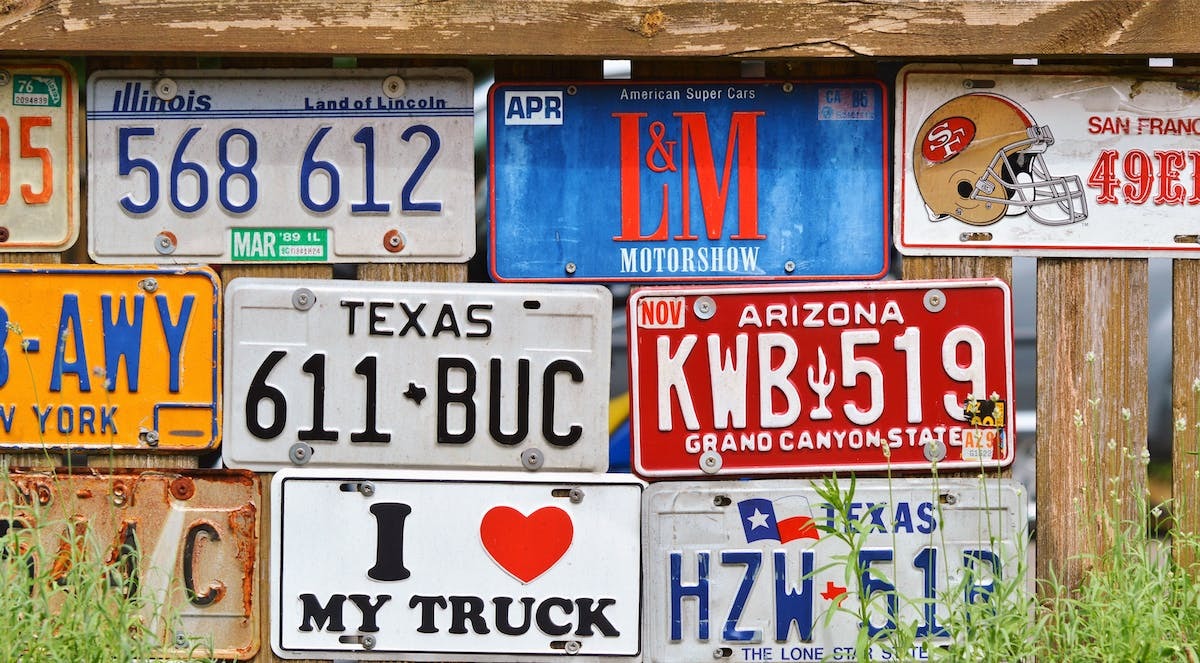
In the United States, one can observe a great variety in the formats and designs of license plates due to the federalist system of the country where each state is responsible for designing its own plates. Some use their official emblem while others opt for tourism slogans to promote their local attractions.
In certain places like Monaco or Dubai, wealthy owners can customize their plates with special combinations or golden characters. This reflects their social status and taste for luxury.
It is interesting to note that some countries have also established temporary plates for transit vehicles or foreign visitors. These plates are often a different color and have a limited duration of use to facilitate the management of traffic flows.
Over time, formats and designs have evolved in harmony with technological advancements. Innovative systems such as augmented reality, artificial intelligence, or internet connectivity are set to revolutionize the very concept of license plates.
Each country leaves its own mark on its license plates. Whether simple or sophisticated, these small metal pieces play an essential role in vehicle identification while reflecting the cultural and national identity that characterizes every corner of the globe.
The numbers and letters that make up our plates: how are they assigned
Let’s now address the numbering and lettering systems of license plates, which add an extra touch of uniqueness to different countries. Each territory has its own rules for assigning these alphanumeric combinations.
In France, for example, the system uses a combination of two letters followed by three numbers and two more letters. The first letters correspond to the department where the vehicle is registered, while the numbers allow for the identification of the owner. The last two letters are chosen randomly.
In the United States, the method varies by state. Some use a logical system based on population or alphabetical order, while others opt for random numbers. Some cities, like New York, have their own specific codes.
In the United Kingdom, there are different formulas depending on the regions of the country. A common combination consists of a set of seven characters including a letter representing the region, followed by a four-digit number and then three other randomly chosen characters.
In some Nordic countries such as Sweden or Norway, the system is based exclusively on the use of alphabetical characters, without any numbers, to facilitate memorization.
License plates: specific rules according to countries
Let’s continue our exploration of the legal and regulatory peculiarities related to license plates in different countries. It should be noted that these rules can vary significantly from one territory to another, with the primary goal of ensuring road safety and facilitating the identification of vehicles.
In Germany, for example, plates must be approved by the TÜV (Technischer Überwachungsverein), an organization responsible for verifying their compliance with current technical standards. German plates are also equipped with stickers affixed to the windshield, indicating the validity period of the technical inspection.
In some Scandinavian countries such as Norway or Sweden, motorists are required to change their plates every three years to prevent them from wearing out too quickly. This measure aims to maintain good readability of the alphanumeric characters despite the extreme weather conditions encountered in these regions.
In the Netherlands, there is an interesting peculiarity: since 2015, owners of electric cars benefit from a special license plate featuring a green ‘E’ followed by the usual registration number. This initiative allows other road users to easily spot electric vehicles and thus promotes them to the general public.
Some countries have also established restrictions regarding the choice of characters used on plates. In Saudi Arabia, for example, the use of numbers on license plates is strictly prohibited. Arabic alphabet letters are used to identify vehicles.
It should be mentioned that some countries require a license plate at the front and rear of the vehicle, while in others, only the rear plate is required. These differentiations may seem trivial, but they reflect the diversity of traffic regulations.
Each country has its own legal and regulatory peculiarities related to license plates. From the specific numbering and lettering for each territory to the rules regarding periodic plate changes or restrictions on the choice of characters used, these aspects contribute to making these essential elements for the identification of vehicles on our roads unique.
License plates: cutting-edge technologies to combat road crime
The technological advancements in the field of license plates have also brought a host of innovations in recent years. One of the emerging trends is the use of smart plates. These devices incorporate RFID chips that allow for automatic and contactless reading of information related to the vehicle. This technology facilitates roadside checks, reduces reading errors, and improves efficiency when it comes to quickly retrieving necessary data.
In some countries like the United Kingdom or France, we see the emergence of connected plates. Thanks to internet connectivity via an integrated modem, these plates can broadcast real-time information about the vehicle such as its location or usage history. They also allow the competent authorities to send notifications directly to owners in case of violations or theft.
Another interesting innovation is the use of illuminated plates, primarily used to identify government or diplomatic vehicles. These plates are equipped with light-emitting diodes (LEDs) that display different colors depending on the vehicle’s status (blue for law enforcement, red for medical services, etc.). This greatly facilitates visual recognition and contributes to better safety on our roads.
There are also personalized plates in some countries. This option allows owners to choose specific alphanumeric combinations, often for aesthetic purposes or to display their attachment to a sports club or favorite team. Although this may seem trivial, it should be noted that this personalization must still comply with existing regulations and not undermine the integrity of the identification system.
License plates have thus undergone a true evolution in recent years thanks to technological advancements and innovations implemented by various countries. Smart, connected, illuminated, or personalized plates not only offer additional functionalities but also contribute to enhancing road safety and facilitating vehicle identification. It will be interesting to see how these technologies continue to evolve in the coming years to meet the growing needs of our society regarding automotive mobility.
License plates: an essential tool in the fight against road offenses
The importance of license plates in the fight against road crime cannot be underestimated. Indeed, these plates are a form of identification essential for law enforcement to trace vehicles involved in offenses or criminal activities.
Thanks to the information engraved on the plates, such as the registration number and the issuing country, it is possible to trace back to the vehicle owner if needed. This not only allows for quick resolution of police investigations but also helps prevent recidivism by identifying the responsible individuals.
In some countries, like the United States, certain states have adopted a particular system called ‘personalized plate‘. This type of plate allows drivers to choose a specific alphanumeric combination that is unique to them. Although this may seem trivial at first glance, it greatly facilitates the visual identification of the vehicle by witnesses or surveillance cameras.
Modern technology has enabled the development of advanced systems such as automatic number plate recognition (ANPR). These devices use special cameras capable of capturing and instantly reading all entries and exits in a given area.