We often observe the same situation: a person has felt a particular connection with nature for years, perceives things that those around them do not, and wonders whether all of this is simply a sensitivity or a deeper calling. Before embarking on a spiritual quest, it is essential to establish concrete markers to distinguish a genuine shamanic impulse from a fleeting attraction to mysticism.
Trance, intuition, hypersensitivity: when the body sends signals
The first area where one can identify a shamanic calling is the body. Not in a book, not in a guided meditation online. Unusual physical reactions occur without a clear medical explanation: intense chills in the presence of certain places, a sensation of warmth in the hands when in contact with a suffering person, or spontaneous trance episodes.
These involuntary altered states of consciousness deserve particular attention. The WHO classification distinguishes trance disorders, which are involuntary and clinically significant, from trances that are part of a recognized cultural or religious practice. Therefore, a trance episode alone does not constitute a sign of shamanic vocation or a psychiatric disorder.
One can recognize the signs of shamanism within oneself when these manifestations repeat in a specific context, for example, in contact with nature or during prolonged moments of silence, and when they are accompanied by a form of lucidity rather than confusion.
Three bodily markers frequently appear in individuals who describe a shamanic calling:
- A sensory hypersensitivity that intensifies in certain natural environments (dense forest, riverbank, rocky areas), to the point of altering the perception of time
- Recurring dreams with strong symbolic content involving animals, ancestors, or unfamiliar landscapes, with a precise memory upon waking
- A spontaneous ability to physically feel the pain of others, sometimes localized in the same area of the body as the person in front
Shamanic vocation or spiritual awakening: what anthropology distinguishes
Many online contents mix spiritual awakening and shamanic vocation as if they were the same thing. In practice, the difference is clear.
Spiritual awakening, as described in most contemplative traditions, concerns a change in one’s relationship with oneself and the world: questioning beliefs, feeling of unity, modification of life priorities. Shamanism involves a specific social role: a shaman is a specialist who uses altered states of consciousness to provide concrete services to their community, such as healing or divination. This is the anthropological definition proposed notably by researcher Manvir Singh.
In other words, feeling a deep connection with the living does not make someone a shaman. What characterizes shamanic vocation is the combination of intense inner experiences and the ability to put these experiences to the service of others in a structured manner.
A term that sparks debate among specialists
The word “shaman” itself poses problems in Western usage. The boundaries of what shamanism encompasses vary according to cultures and eras. Applying this label to a personal experience lived outside any traditional cultural framework can be misleading. Shamanism is not a diagnosis of individual potential but a collective framework rooted in transmitted practices.
Intense spiritual experience and mental health: establishing the right markers
One cannot talk about shamanic signs without addressing a delicate area. Some manifestations that resemble an awakening (visions, inner voices, a sense of mission) may also signal psychological suffering that requires clinical support.
The recommendations discussed in the clinical literature on spiritual experiences invite evaluation of several criteria before concluding anything:
- The impact on daily life: can the person continue to work, maintain relationships, and sleep properly?
- The presence or absence of suffering: an authentic spiritual experience can be unsettling, but it does not disrupt the person’s functioning in the long term
- The cultural context: a trance experienced within a recognized ritual framework does not have the same meaning as an isolated and involuntary episode without any community reference
- The duration and safety: brief episodes followed by a return to a stable state differ radically from prolonged states with a loss of contact with reality
An intense spiritual experience is not sufficient to establish a psychiatric disorder, nor to rule it out. It is the entirety of the situation that matters. Anyone experiencing destabilizing manifestations benefits from discussing them with a healthcare professional open to the spiritual dimension, rather than relying solely on frameworks found online.

Concrete practices to explore one’s spiritual potential
If after this sorting, it is determined that the perceived signals indeed relate to shamanic sensitivity, the next step involves practice, not reading.
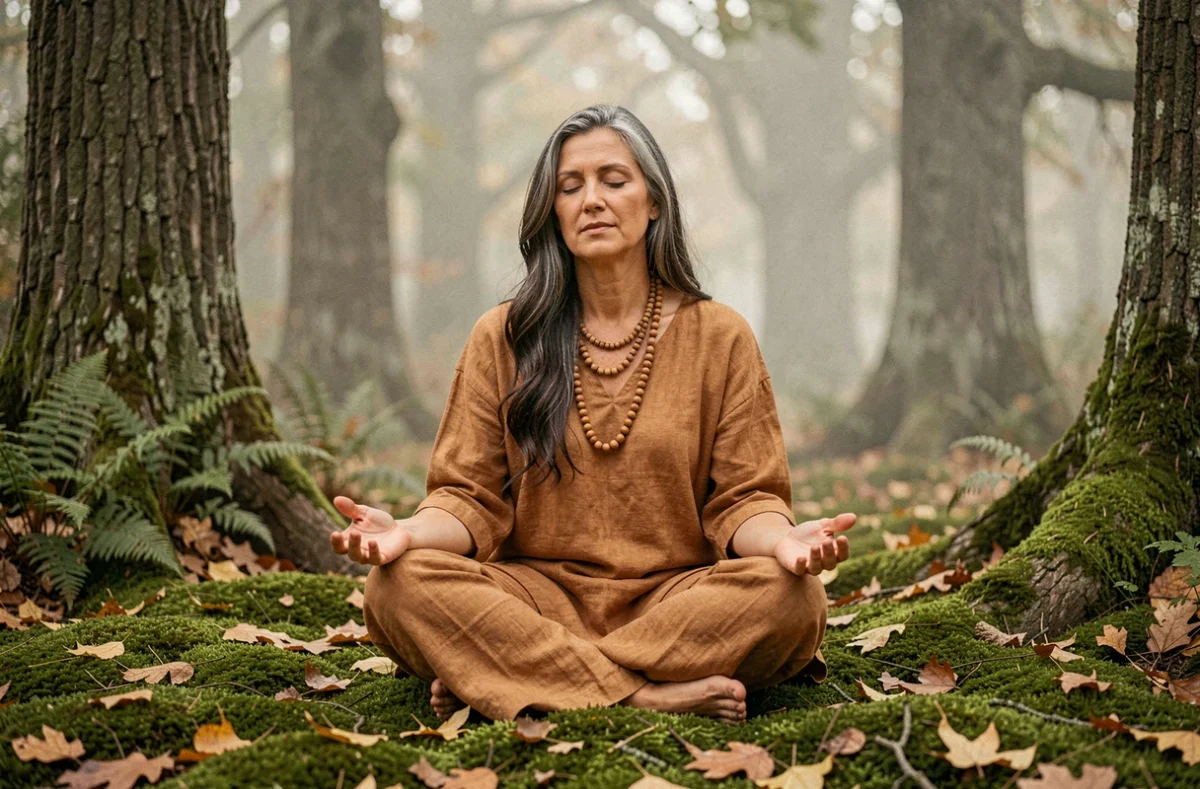
Regular contact with nature forms the foundation. Not a distracted walk, but a silent and attentive immersion: listening to sounds without naming them, observing animal movements, remaining still long enough for the environment to “forget” our presence. It is in these moments that perception naturally shifts.
Meditation focused on breath and bodily sensations helps stabilize altered states of consciousness rather than merely enduring them. The aim is to develop the ability to enter a state of heightened receptivity and to exit it voluntarily.
Finding a framework for transmission
The shamanic path is transmitted through shared experience, not through self-training. Seeking a practitioner or a circle that is part of an identifiable lineage, with codified practices and an explicit ethical framework, remains the most reliable approach. Caution is advised regarding offers that promise “shamanic awakening” in a few workshops without any grounding in a living tradition.
The boundary between spiritual sensitivity and shamanic vocation remains porous, and it varies according to the cultural context in which one evolves. What matters in practice is the regularity of commitment, the quality of support, and the ability to remain lucid in the face of one’s own experiences.